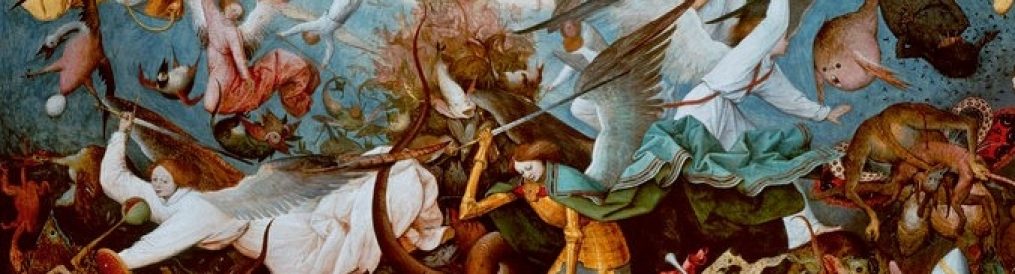
In the beginning, God said, “Let there be light,” and God saw the light and said that it was good, and God divided the light from the darkness. This dividing of light from darkness is the spiritual division of good and evil and of knowledge and ignorance.
The Creation of God is a temporal physical model patterned after invisible things that are eternal, for it pleased the Lord that through the creation of similitudes, knowledge would be made manifest to those whom he had created, and that both good and evil might be made known.
On the fourth day of Creation, the Lord again did as he had done in the beginning when he spoke the Word commanding the Light to come forth, only this time in a physical sense as a sign.
Therefore, he created the sun to divide the day from the night, along with all the heavenly luminaries, the moon and stars, to give light by night—a sign that the Word, the Light of the world, would appear on earth on the fourth millennial day—four thousand years from day one.
The Lord placed the sun in the heavens, not to be worshiped, but as a physical sign of the true Light spoken of in the beginning. The true Light in the beginning is that Light spoken of by John, stating, “In the beginning was the Word, and the Word was with God, and the Word was God.” And again in Revelation, John writes that Christ is “the faithful and true witness, the beginning of the creation of God.”
And this is the witness of John: that Jesus Christ is “the true Light, which enlightens every man that comes into the world. He was in the world, and the world was made by him, and the world knew him not.”
In ancient Middle Eastern civilizations, those who did not know God worshiped the host of heaven, chiefly the sun, the moon, and other celestial bodies. Man-made idols were integrated through syncretism, a blending of beliefs where physical idols served as earthly extensions or embodiments of divine powers in the cosmos. In essence, they worshiped the creation rather than the Creator.
Christ is to be worshiped, certainly not the sun, which is but a similitude set as a sign in the heavens. Similitudes were created by the Great Instructor as an apparatus to teach spiritual things through physical examples. The physical characteristics of the sun can be related to the Lord’s own life-giving attributes: warmth, purification, healing, growth, and the giver of light.
The sun is exalted as a bridegroom coming out of his chambers (Psalm 19). The moon is the bride of the sun, reflecting the sun’s light upon the earth. These three create a figure: Christ, his bride, and humanity, of which much more can be said.
Jesus said, “I am the light of the world; he that followeth me shall not walk in darkness, but shall have the light of life.” How often in the scriptures is day used as an expression of spiritual enlightenment and night as an expression of blindness and spiritual darkness!
Nothing the Lord created is without design, purpose, intent, and meaning.
The Bible says that by two or more witnesses the truth shall be established. God gave Pharaoh two dreams; Joseph revealed to him that the two dreams were one. He told Pharaoh God had doubled his dream because the thing was certain. The Lord always provides two or more witnesses to the truth of his word.
It was taught among early Christians and the Jewish sages that there would be 6000 years (six millennial days) allotted to man for his dominion on the earth to be fulfilled. The six days are divided into three ages, each age consisting of two millennial days, giving two witnesses for each age. There were two millennia from Adam to Abraham and two millennia from Abraham until Christ, leaving only two millennia to be fulfilled until the millennial Sabbath on the seventh day.
The second millennial age consisted of one millennium from Abraham to David, followed by one millennium from David to Christ. Both Abraham and David were given the same promise of the Messiah issuing from their seed. Thus, we have two witnesses, Abraham and David, testifying to God’s promise of the Messiah that was fulfilled in Christ one millennium from David, ending the second age.
After the six thousand years are complete, the six days of labor commanded by God are finished. Then comes the seventh day, an eternal day of rest, for God finished all his work in six days, and he rested from all of his work on the seventh, which is the Sabbath.
 𝐒𝐤𝖆𝖗𝖇𝖚𝖙𝖙